
We don’t know who these men are but we do know that they are stood outside no.1 and no.1a Cleveland Row, Stockton c1928. These houses were built in the 18th century and stood here until the area was cleared c1929.
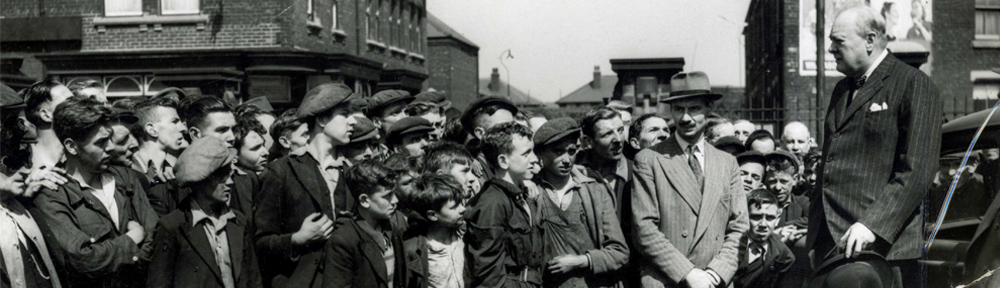
We don’t know who these men are but we do know that they are stood outside no.1 and no.1a Cleveland Row, Stockton c1928. These houses were built in the 18th century and stood here until the area was cleared c1929.
Cleveland Row, the Thistle Green area, of Stockton-on-Tees, was demolished and the parcel of land it stood on is now under and abutting Riverside Road, south of where the Co-op Dairies Depot used to be, overlooking and facing the River Tees. John Walker, the inventor of the world famous friction match lived in Cleveland Row, with his mother and sister.
Alan B. (a fellow contributor) on January 23, 2005 at 12:00 am wrote about Cleveland Row as follows:
Quote
“The Steps” at the riverside end of Smithfield appear on the left of this photograph t1657, and have been painted by T.Batty in picture s479 titled “The Steps, Smithfield, Stockton.” Cleveland Row is the grand central terrace to the right of the steps, with the ferry landings below and buildings of the Ropner Shipbuilding Company on the far right. To the left of the steps is the quay and part of the Ship Launch Inn building. Thirsty shipworkers arriving off the ferry from the yards on the opposite bank could turn left straight into the Ship Launch Inn, or move further down the quay to the Baltic Tavern, or up to the pubs around Thistle Green, like the Three Tuns. Some residents mindful of this potential trade ran drinking houses in Smithfield with the Shakespeare Arms (A.May Groskop from No.2) and the Wellington Inn (T.Shaw from No.7) being long term examples. A view of the derelict Ship Launch Inn with Cleveland Row in the background appears in t6627 = Ship Launch Inn, Stockton, 1928; with a view in better days in t5248 = Recollections of a River. Another view of Cleveland Row appears in s494 = Ropner Shipbuilding and Repairing Company(Stockton)Ltd. s494 is from the same era as t6627 as proved by the light poles, but a different date due to the painted sign on the far right industrial building. The impressive Georgian doorway of No.3 Cleveland Row is photographed in s492, with No.1 in s493. The Ropner buildings survived for many years and can be seen in s200 = The Square, Stockton, 1960s.