This is Norton old Station. The view is towards Blakeston Lane, the railway line heading for Ferryhill. Probably taken from Junction Road bridge near the garden centre. (This information was kindly provided by Alan Betteney)
Norton rail Junction. To the left is the west curve and original 1833 track-bed to Stockton from S.W Durham coal-field. Still in use. 1837. A ticket Office,Waiting-room and 6 single storey rail-workers cottages. The move to Calf-Fallow Lane of Norton Station 1877, saw the Ticket office and waiting room as Junction Methodist Chapel till the late 1960s. All demolished (derelict) at the end of the 1970s for Harpers Garden-Centre. Background, behind the signal gantry is the Inspectors House, still inhabited and the brick built boiler-house (demolished). An East Curve (not shown) was opened to West Hartlepool in the 1840s,still in daily use to Newcastle-Middlesbrough (This information was kindly provided by Carol Fox)
This is the original station at Norton Junction looking north from the westerly one of the two bridges on Junction Road. Harpers Garden Centre now stands on the land to the right behind the buildings and directly behind them is the site of the first east to south curve which was subsequently replaced by the present one. (This information was kindly provided by andrewpearson) 
Picture Stockton Archive
A Pictorial History of Stockton-on-Tees
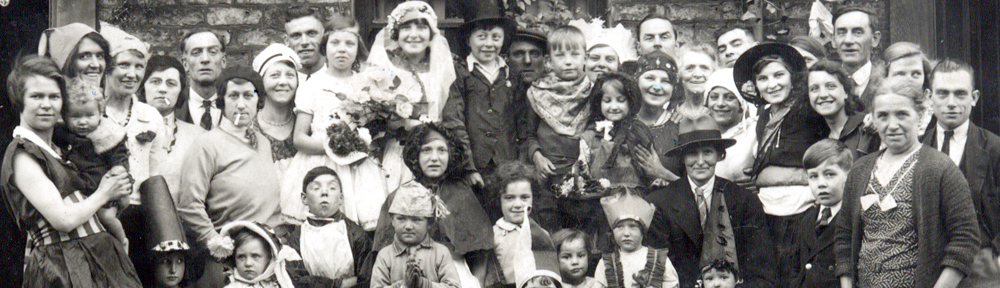
My great-uncle, (Charles) Clifford Stanyon, was the station master at Norton. I’m not certain of exact dates but he was definitely there in 1939 and sometime afterwards. His wife was Ethel and he had (at least) one son, Clifford Neal Stanyon. I’d be delighted to hear from anyone with memories or more information about them. The wider family lived in North Ormesby.
Further to others comments re the title picture from Junction Road bridge, a couple of those buildings, although derelict were still present after the opening of Harpers, I note that some have commented that they contained houses, which being on the platform would have been inconsistent with established LNER / ER practice. These would have been offices, waiting rooms etc, and wonder if they are confusing the (still extant) row of former railway houses on the opposite side of Junction Road, behind and to the right of the cameraman, located between the two over bridges on Junction Road that include the bridge the picture was taken from and its sibling that spans the curve from Stockton Bank / Norton South Jcn round to Norton East Jn.
As an aside the signal close to the bridge (see title pic) was removed in the 1990s. The line featured runs from Norton West to Norton South is also still in use, but sees a greatly reduced amount of traffic with the general decline of rail freight around the area in recent years. Network Rail do have plans in place that will see the closure of Norton South (which is now Grade 2 listed) and East boxes, with Norton West remaining and would control the crossing and the remaining signals for the norton triangle. the resignalling etc that goes along with all this was scheduled for 2018/19 but has been deferred because of “re-prioritisations”and other projects, and as such the boxes as they are, will remain for the next 5 years at least.
Bert amongst those buildings was a church. My g’grandfather worked on the railway as a mason and his address was Norton Junction so maybe there were residential housing there.
Re Bert Quigleys comment regarding the houses: They were indeed used as houses, though I believe that originally may have been station buildings which were subsequently converted. I know this as my mother and her three siblings grew up in one of them as my Grandfather, Sydney Clayton, was a railway signalman and initially rented the detached house visible in the background from the railway company and then latterly, one of these two cottages. I know that with 6 of them in the house conditions were very difficult. I can still remember as a child sitting by the window looking out over the tracks and seeing the massive wheels of a locomotive waiting for the signal to change towering over us. Obviously when a locomotive went past it was very noisy.
Apparently in WW2 the triangular area of the junction came under incendiary bomb attack and its said that when outside shovelling earth over the bombs to put them out he stood with the shovel over his head for protection.
Mike Hanson
Mike Hanson, I remember your g/father working as a signal man near to where he lived. Me and my brother used to hunt rabbits on the railway sidings near where he worked and we would share our kill with him during our get warm in his cabin in front of a blazing fire. Also his son Eric, although a couple of years older than me we both attended the FN school before he passed the 11+ exams and he went onto the Stockton Grammar School.
On Tuesday morning, an engine driver named George Sweeting, belonging to to West Hartlepool, whilst taking a goods train from Hartlepool to Welbury, and when near Norton Junction, fell from his engine, and had both his legs run over by a goods train passing on the down line. The unfortunate man had been stepping off the “tender” end, after depositing his oil feeder in a box, when his foot slipped. In falling he clutched at the wagons of the goods train on the opposite line, but could not retain his hold, with the result that the last half of the train passed over his legs. He was conveyed to the West Hartlepool Hospital, where he died soon after admission. Dated 1893
Tom Sweeting… very sad.. Unfortunately death while at work (especially on the railways seemed to be all too common. My own ancestor, John Elgie was also killed on the railway near Welbury station in 1899. I have the original coroner’s report which confirms while working of the tracks a train crashed into him and he was confirmed ‘dead at the scene’… His son George Elgie was also killed on the railways at York in 1898.. John’s daughter Jane (George’s sister) husband William Myers Robinson was also killed on the railways at Stockton on Tees in 1902. I found the obit in the Gazette. I have asked historians why they didn’t simply get out of the way! I was told logically I suppose that in the late 1800’s and early 1900’s people were used to horse traffic being very slow wouldn’t have been used to the speed of steam trains.
My Great Grandfather was Thomas Stammers Webb who had an iron works at Norton in the 1870’s. The 1871 census shows his children living in Norton with an aunt Eliza Emery who was born in Switzerland. Thomas made iron railway lines and had a steam ship built at Stockton on Tees called the T.S.Webb which sank off Dungeness in Kent in 1871/2 whilst en route to Tangarog in Russia loaded with iron railings 13 of the crew perished and the ship was only minimally insured. The Emery’s were involved with the railways and were engine drivers. Does anyone please have any knowledge of the factory or the family please?
Interesting to see that comment about an iron works at Norton, making railway lines, and exporting them, as far as Russia, Quite an accomplishment. These factories and their workers, which have done so much, for the prosperity of the nation, should be proudly remembered.
I once read that Big Ben was first cast at an iron works in Norton. Sadly it broke, (probably caused by hitting it much too hard!)
The other four bells, called the Westminster Chimes, which were also said to have been cast at Norton, are still going strong. Famous around the world!
Norton has a lot to be proud of…
Yes the bell was cast at the Norton Iron Works. My grandfather told me that it was men from the Norton Iron Works who walked on the Jarrow protest march to London.
Wasn’t it wonderful to read about manufacturing exports from Norton. As far as Russia!! Just what has happened to manufacturing in England? We don’t seem to make much these days, compared to years ago.
There have been 2 east curves, the first a sharp curve, but after derailments a less sharp curve was built around 1870. This is the one still in use, I believe before 1870 Junction Road was at rail level with a crossing as opposed to bridge, (hence the name Junction Road), the actual points may have been on or next to the crossing….I think.
Thanks Eric, is my face red, I must get my specs changed. I dont know what Freddie Moiser would say! I was also glad to read your piece, Dorothy, about Mr Tom Walls. Did C.V Armitage follow Mr Walls as Churchwarden? I sang in St Mary”s choir in 1939 when Mr Harland was the organist and choirmaster.
I knew you could put me right Dorothy, on the christian names of the Walls. When Tom Walls worked the garden he never used the door that led out onto Parsons Walk. As you say it must have been work for the Church and there must have been a way through by the Vestry for him. There were fruit trees growing against the high walls inside the garden. I often tried climbing the walls to reach the fruit. Can you remember our attempts Dorothy?
The “monstrosity” is a railway signal – you can see the two arms – the upper one is a home signal operated from Norton West signalbox, the lower is a distant signal operated from Norton South signalbox.
Does anybody know what this great industrial monstrosity is that has been built next to the Chapel door? It was not there in my time 1930-1951. These bridges were a favourite spot of mine for train watching from my early pram days. I am 80 now and just last week went to York Station to take some camcorder shots of the new Peppercorn Pacific steam train Tornado leaving for Newcastle. I had the pleasure of showing it to my Grandson Aston yesterday afternoon – more Grandad! What a great sight it was with thousands of people turning out along the track. Two platforms at York were full of people
With regards to the name Walls, it wasn”t Tom it was Willie Walls who showed the Champion Bulls.
With regards to the walled garden up Parsons Walk, Bob, I thought it belonged to the vicarage. As J Norman Kidd says, Tom Walls was a ex Warden of St Mary”s, so it may well of been him tending to the gardens. My memory of Tom was him coming to see the boss of a market garden where I used to work many years ago.
If your school friend”s sister”s was named Joyce, Peter, they still have a farm but it is now a Garden centre, first on the right over the railway crossing on Blakeston Lane.
Yes it was Tom Walls, Bob. I did not dare trust my memory for his christian name, but I was correct it was indeed TOM. We spoke on many occasions while waiting for the bus which stopped outside their house for the Grantham Road stop. Are there any more old Junction Road, Grantham Road, Whitfield Road or Nrth Albert Road survivors still around?
With regard to the name Walls, I think there was a Walls who worked the Walled Garden (not a pun) that ran alongside the Parsons Walk nearto Ragworth Place. (Probably Dorothy Smith can make a comment on this?)
The farm Bob is talking about, first on the right past old redland tiles, Mr Tom Walls, Tony Smith (Smith family )owned it in 1972 as my old school friend, Tony Jacklins sister married Tony Smith. The smith Family owned the first three farms on Blakeston lane back then.
Yes, you could get into Howdon Hall by two ways if you went down Blakeston Lane over rail crossing and there was a track on the left hand side, as Alan Duel would say it was the tradesmans entrance, and the other way in was just past the Horse and Jockey on Durham road A177 and first right past Somerfield superstore there is a old keepers cottage beside the entrance, the last time I was there would have been about 1979. The house reminded me a lot of Wynyard Hall from the outside, but the inside was fantastic with a massive kichen at the back and the sitting room was like somthing of a stately home with a huge open fire and stone fireplace. It also had a saddle room etc. At some point it must have been built for the gentry, I just hope whoever has got it now keeps all the original features as it would be a shame to spoil our local history. I was just wondering – as the place looks very much like Wynyard Hall, is there any connection?
As a boy growing up in Norton and my Grandfather being a Market Gardener we were always interested in the Stockton Agricultural/Horticultural Show held mainly at Ropner Park. Every year the Champion Bull was owned and won by a Mr Tom Walls. His Farm was on Blakestoln Lane. It was the 1st on the right after the railway crossing. I don”t know what the Farm is called but it is now a Garden Centre.
Are you talking about Howden House on Junction Road opposite the William Newton School, Peter? If so, I recall it well. My parents moved into Grantam Road houses when the were built new in early 1930. Mr Walls, an ex Church Warden of St Mary”s Church, owned Howden House. Before comming to live there they owned an ancient farm, I believe it was Hardwick Hall the top side of Blakeston Lane. They were an old Norton family, he had a very deep voice and you always knew when he was in church, he was also very strict. As a small boy I knew most of the Railway Cottages families but in particular Buddie Birtle when most of us attended Freddie Nattress School. I think Bob Harbron and Bob Irwin will probably confirm this.
Howdon house is still there but it was up for sale about a year ago. It was owned by Alan Duel and his wife Maureen, she had the florist shop beside the Red Lion on Norton High Street. Regarding White House farm, I think Laurance Smith still has it, and his father had the one on the bend on Blakeston lane, and it is still in the Smith family. They also own Leeks DIY in Mill Lane, Billingham.
My great great grandfather lived in White House farm, Norton-on-Tees in 1771. He was called Robert Smith, and his 11 year old son, Christopher, was my great grandfather. Does anyone have any memories of White House farm? It was listed on the 1871 census as being between white house plantation and Mrs Watson”s cottage, then there was Howdon House. Is it still there? Did it have any connections with the white house on the green?
I have recently found out that my grandfather, Robert Marshall, born 1890, lived with his family in a railway cottage, possibly number 7, at Norton Junction until 1930 when they moved to York, where he was an engine driver. At the time he lived at Norton Junction he would have had 6 children, including twins Thomas and Frederick. His wife was Annie Peat-Gaull. It was my Uncle Tom who recently gave me this information. I wonder if anyone has any memories or knowledge of Robert Marshall and his family at that time.
Colin. Are you Oswalds brother? I am Mavis Laycock’s daughter and now live in Northumberland. Mum mentioned you and Kath the other day?
Kind regards
Gail Lawler
PHIL MAY NOT REMEMBER ME BUT WE USED TO PLAY TOGETHER WHEN WE WERE KIDS ON THE TREE SWING IN HIS GARDEN. MAMS NAME WAS WINNIE AND WE LIVED IN 16 CALF FALLOW LANE RIGHT NEXT TO STEVENSONS FARM WHEN JEFF AND KEITH USED TO HAVE THE DAIRY THERE.
I am one of the Youngs, my mam Annie was friends with Winnie Morgan.
My father owned the station masters house at norton-on -tees railway station, calf fallow lane from 1959 to 2005 he was a railway man with 35 years service at thornaby loco shed he came from scarbrough loco shed originally where he did york to butlins filey any railway men out there who new him please leave a mesage on this web site he knocks about with charlie smith , eric grud , both from roseworth he is now 75 years old and would like to hear from old work mates thanks. I will keep watching this web site now for replies
Phil – I think you mean Eric Grubb,he had a brother called Tommy who was also a long time railwayman.Both sadly no longer with us.
Phil, I worked with your father at Thornaby when I was a young railwayman and then driver. Nice guy. Remember coming along there with a train one day and your dad was up a ladder cleaning the windows. I gave him a right tooting!!
Phil Charlton. Thornaby 1979-87 & 1988 – 90, Darlinton 1978-88
Hello Jonathan. Yes I knew your father, Ted, and also his brothers and sister Dorothy and your grandparents. I was a little younger than your father so did not know him as well as I did your uncle Eric who was nearer my age. I lived in the Inspector”s house with my parents and sister(No. 14 Junction Cottages),your grandparents lived in No. 13 and the Hartburns in No. 12. As you say, it was sad to see the cottages and the little chapel demolished. Ironically Harpers Garden Centre which was built on the nearby field and on some of your grandparents land, has now been demolished to make way for housing.
My father was William Edward “Ted” Clayton who grew up in the cottages in the foreground. Does anyone remember him? His brothers were Eric and Ken, and his sister was Dorothy.
Hi to Terry and Christine Thank you for you comments on the Dawson and Bell Family my email is graham1966rosie@hotmail.com. I would love to hear more about the family and share any information i have found. Rosie
Rosemary Haley, I have researched the Bell family and the Dawson Family for some time. You can find a lot of information from Grave stones in St Mary”s Church Yard Norton Stockton,where there are many head stones which are very informative, around 10 members of the Bell family and Thomas Bells obelisk.The Dawson family are as Terry says are Farmers in the main.
Rosemary Haley, in reply to your request for more information about the Dawson family who lived in & around Norton there are several people including Christine & myself who have family trees (some available via the GenesReunited website) which include quite a bit of information about the Dawsons back to 1800. The Dawsons originally lived & farmed at Claxton near Greatham on the road to Hartlepool. If you have an e mail contact I will try to update you with what I have been able to glean second hand from several people.
After doing a Google search on Hornless Farm this web site was found. Christine Walters commented on the farm and went on to mention her Gt Gt Gt grandfather was Thomas Bell who is also my Husbands Gt Gt Gt Grand father. I would appreciate any information on this Family or on the Dawson family of which Thomas married Ellington Bell.
I worked with Joe Heathwaite when he was a relief signalman in the sixties but he then lived in the row of railway houses that are in the dip fronting junction road I believe the land behind those houses was the spoil dug up when they made the cut from Norton south to Norton east Joe was a great character and I remember him telling me he had been a Barnados boy he lived next door to another signalman called Tom Heward
Hello again Bob. Yes I was aware of this photo of my parents house being on the Picture Stockton site. Found it by chance some months ago and have noticed quite a few comments have been recorded since then. People have commented about Bells Sidings but they were also known as Pear Tree Sidings presumably named after the large pear tree which used to cover the lefthand side of the house. The little chapel to the front of the photo has also been recorded on this website. The Hartburns lived in the first cottage and the Claytons in the second. On the other side of the road lived the people you have named. Did you mean Joe Heathwaite who was a signalman and a cobbler in his spare time? He had two sons and a daughter. There were also the Pooles, Pottages, Fellows and Hutchinsons. Ann Rowntree and Joan Heathwaite both worked for Sid Smith who had a market garden off Junction Road. I also remember your grandfather having his market garden and remember the Glebe houses being built and also the Roseworth Estate.
Hi Pam. You will find this photo very interesting. As you can see your house in the background. I can remember a few names of people from this area. Eric Clayton who lived in the row of buildings in the fore ground. Ann Rowntree who went to School with me who lived in the Railway Cottages and also the Birtles.Winnie Birtle and also her brother Tom who played cricket For Norton and Northants. I can also remember a Signalman living in the Cotteges and had a son and daughter but I can”t think of their surname. My Grandfather who had the Market Garden worked the fields on the right of your house when he had to vacate his fields which are the Glebe now. Just remembered the other name, Windross.
Norton Junction Correction , It was Robert Linton, as requested by Faith Davison, not Robert Barrowby as printed ,sorry
Norton Junction – Robert Barrowby had a Market Garden in JUNCTION ROAD, in the the present Ashville Avenue area he lived in Barrowby-House, N.E of Norton Church, only “Woodbine” house (flower, not cigarette ) remains of that block. The present Billingham Ring-road, behind “The Hermitage” is on the site to-day
We used to live in Woodbine House a long time ago. As I kid, I could never understand why it was named after a cigarette.
That Made me smile Marsay, knowing the house and also having walked the hedge backs with my Aunt Mabel Marsay on their farm looking for Herbs and fruits, she knew the name of every wild flower and what was good in medicine or as a tonic. It was a time long before the NHS and Ambulances on call, you dosed yourself or Aunt Mabel dosed me and just about everyone for miles around, the instant cure could well have been her home made wines that were the base for all her cures.
Houses were often named after wild flowers as you probably well know, Woodbine was common Honeysuckle or its correct name Lonicera Periclimenum.
My best Friend Dennis Goldsbrough lived there, they moved from Somerhouse Square in the middle of Norton High Street to Woodbine which was then on the entrance to the Rugby field at the top of the Showfield off Station Road. After the war they moved to a Bungalow on Hartlepool Road. I have happy memories of that house, Mrs Goldsbrough was a lovely Lady a friend of my Mother. The story goes they were both in the Stockton Maternity Home together, there had only been Girls born since the New Year then I arrived on the scene around one in the morning of the 19th February, Dennis waited another hour so I was the first Boy born in the home that year. well that is the tale I was told.
It was a lovely old house even back then and I was glad to see it survived the making of the ring road, I still smile as I pass always looking to see if the name plate is still there.
Frank.
I wondered if anyone knows anything about Robert Linton who was a farmer in this area in the 1880s he was my greatgreat-grandfather,I would like to find out more this man thanks. Faith
Hello Bob I myself have found the Obelisk in St Mary”s graveyard Thomas Bell worked for the railway for 47 years and lived in the inspectors house with his wife Barbara and his many children maybe the sidings were infact just called “Bell”s sidings” because of the family that lived there. If you look around the obilisk you will find most of Thomas Bell”s family and his offspring. There are about eight or ten Bell gravestones in all. There daughter Ellington Bell married Thomas Dawson Cow keeper and milk dealer of Hornless farm Norton and later 1890″s Calf fallow lane. Thomas Bell is one of my gr gr gr grandfathers
The book Triumph and Beyond by Brooksbank (p.142) notes that Bell”s Siding was earmarked for wartime mobilisation purposes (WW2). RAOC traffic utilised available track space during WW2. By the 1950s, BR documents list Bell”s Siding as a “Public Delivery Siding”, ie it handled public traffic, until its final demise of 6 July 1964. The downgrading of May 1960, just after the closure of Norton-on-Tees passenger station (March 1960) may have made admin/dispatch of small loads from the area(if any)less viable. BR publication 223/1, RCH 61150, L10 of May 1960 covers the revision of both sites. There were two quarries behind White House Plantation, the larger elongated quarry opposite the tile works, and the older one further east of the first mentioned quarry.
Norton Junction Dave, Hawes Wood or as it was locally known “Ozzy-Wood” was a camp-site for the Stockton & Thornaby Scouts from the 1920s till about 1950, when pollutants made the stream, used for both cooking and washing, toxic . Re the stone sleepers , we were told , by the local frmer that these were the early type of rail support and were in use to transport hand or horse drawn wagons of earth, gravel and sand to the main line of the Clarence Railway to buld the Billingham Beck embankment of the 1830s In the 1930s a number of rusting four wheel, iron-framed bogies were scattered in the undergrowth around the original track
Bob, There were sidings on both sides of the “back line” – one set was behind the Inspectors house, the other set as you remember were on the north side of the line & used for storing out of use steam engines in the late 1950″s – early 60″s. There was also a line which ran of to the north from the back line – I believe it went to the quarry which was in Ozzy (or Foggy wood)- I have photographs of the cutting through which the line ran (now underneath the golf course), there were stone sleepers in the cutting. There was also a bridge over the stream made from redundant rails & this was still being used by golfers for access to the 2nd or 3rd hole when I last visited the course some years ago.
Re “Bells Siding” at Norton Junction This morning I went into St Marys Chrchyard to look up the details on Mr Bell obelisk The Clarence Railway crest is carved ,inside a wreath above the following Mr THOMAS BELL . C.E ERCTED BY THE NUMEROUS FRIENDS TO THIS EMINENT RAILWAY ENGINEER 1801-1875. Thomas Bell Stockton & Darlington Railway 1827 Clarence Railway 1837 West-Hartlepool 1840 North Eastern Ret 1864. 37 years service
Just a thought, could this have been named in the 1850s, when the biggest load carried at that time left Norton for West-Hartlepool shipment , from the Norton-Iron Works The 15 ton “Big-Ben” BELL . We knew this line as the “Back- Line” and was the resting place for many steam-loco”s prior to towing to the scrap-yards in the 1960s-70s. Another reason, One of the earliest Railway and Track engineers first with the Clarence , then West-Hartlepool and finally the N.E.R was a Mr Bell , whose obelisk and tomb with the Clarence Rail crest stands in St Marys Church Yard the Green Norton .S.E of the Church Earth lines both to the R.A.O.C depot and Norton Iron Works track are still visible, The Supermarket on Durham Road , is partly built on the dump site as is a section of the Blakeston School playing-field
This photo has been taken from the Bridge on Junction Road nearest Blakeston Lane. On the R/H side of the picture is where Harpers Garden Centre is now. The building in the background is the farmhouse where Donny Wardle lived. He was our local Milkman. The trees in the background are where the Redland Tiles Factory was. In later years Road Frieght lorries used this site and I can remember the frieght containers with Bells written on them. Maybe this is the reason for the back siding which borders the Redland Tiles land being called such.
British Railways documents (1956) list the nearest freight facilities as Norton Junction Siding (Bell”s Siding) on back of E-W curve (July 1964); Norton-on-Tees (August 1964); Stockton Concrete Works; and Crook”s Farm Siding between Norton and Billingham; with traffic limited to truckloads from May 1960 for the first two mentioned sites, deleting smaller loads. Some complete closure dates in brackets. The former RAOC ammunition depot is not listed by 1956. Why was the back siding called Bell”s Siding?