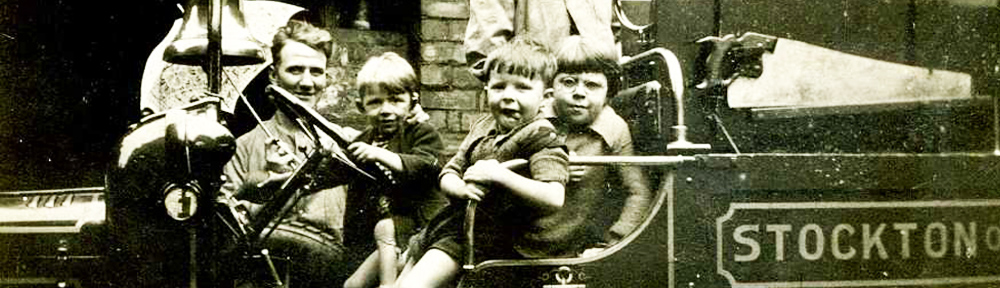
It is hard today to picture what life was like in an age without modern transport systems. Can you imagine how you would get around without a car or public transport? Transport would have been somewhat slow. Coal that was needed for family’s homes in Stockton was carried first on the backs of packhorses. It was hoofed over the hills of county Durham to the towns, and also to the sea for export. As the roads got better the coal was transferred to carts, which the horses had to pull. A horse may pull 1 ton of coal up to 9 or 10 miles a day!
To cover the cost of the carter’s wages, the maintenance of the carts, the purchase and keep of the horses and the tolls paid at the turnpike gates, the coal had to be sold in the towns at as much as three times the pithead price.

Once coal arrived in Stockton the wagon-driver or pack-man made sure he stayed to the North of the Town-hall, as crossing the Borough Boundary as opposed to staying in the Township, would incur Toll (a modern marker plate is set in the pavement (W) nr the “Halifax Building Soc” office, another on pavement (E) by “Albermarle Security”, (2007) thus early merchants stood on what is still called “Coal-Hill”, opposite Dovecot Street to await the servants and town-folk, with their wheel-barrows and carts.
I believe coalmining in Co. Durham had first been licensed in the 13th century. There was also competition between those engineers who wanted travelling steam engines and those who believed it was more efficient to use stationary engines to drag the wagons from point to point.