A horse and cart used by Stockton Co-opertive Society Limited. 
Picture Stockton Archive
A Pictorial History of Stockton-on-Tees
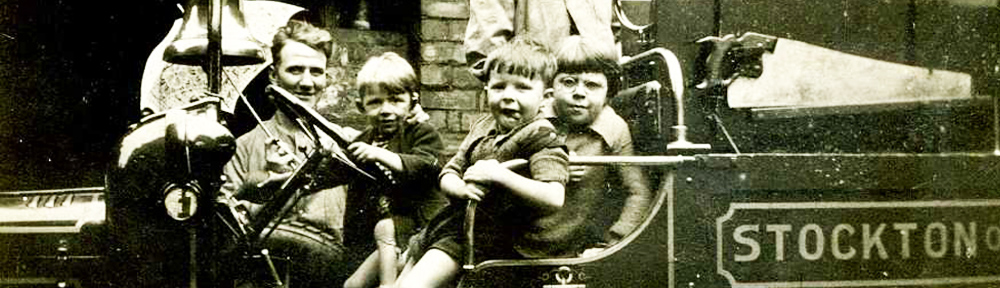
A horse and cart used by Stockton Co-opertive Society Limited.
I think you would find Neil the reaper binder, ours was horse drawn, had a blade working like scissors which was moved by a set of cogs from the wheel along the base of the catcher. The moving arms swept the corn against the cutter and on to the canvas or wooden catcher where the corn was moved back to a binder tied and dropped off the back. All clever stuff when you saw it in action. We walked behind in groups or pairs and lifted the bundles into stooks of eight bundles with the grain upright. Once dried we would on fine days toss it onto the cart with pitch forks, quite an art which even the women mastered as it was all hands on deck to get the harvest in and stacked then thatched to make the stack water proof. We would then wait for the thresher arriving to remove the grain from the straw. The last cut was the signal to get the guns out, we would line up and the harvester would start along the back, as the rabbits, rats, field mice and other things shot out of the edge we got the rabbits. You only fired ahead and never turned with an unbroken weapon, that is the barrel unlatched and swung down from the butt so it cannot be fired. I started to turn once and got such a clip on the ear it never happened again. We did eat a lot of rabbit pies but we also sent many to the butcher to sell. I watched my mother skin and gut rabbits ploat geese cock birds and ducks. She would do a dozen of each at Christmas for sale and our own use, we always had goose. It was what those women did then and thought nothing of it having being brought up to it. I had watched animals killed for our own use from being able to walk and helped when old enough. We butchered the carcass the same day and started to salt it all down to preserve it before it hung for months, some of the hams hung for a year. With no fridges or freezers in the home we had ways and means of keeping food, to my mind better than today’s way of doing things, do you know any woman who would skin a rabbit in five minutes flat today.
Frank P Mee’s recent comments on farming brought more memories back to me. Most of the local kids went “tatey-picking” or “spud-bashing” each October. The schools had a week off for this. Ten-bob a day. We would have to be in the farmyard for 7.30, when the farmer would line us up and pick out the ones he wanted if there were too many of us. We would stand on our tip-toes and push our chests out trying to look bigger and stronger in order to be chosen. The tractor pulled a machine which scooped into the furrows and flung out the potatoes as it passed. Each pair of kids had a stretch of field about 40 yards long to work. You had to gather the potatoes in wire baskets and load them into sacks before the tractor came around again for the next row. Hard work, but oh, the bliss when break-time came and they brought hot mugs of sweet tea and scones for us all! Another memory I have is of the corn being reaped. The reaper was a machine with large rotating wooden blades (I suppose they must have had steel edges to cut) and it pulled the corn inside it, somehow tied a large bunch of it with string and threw out a sheaf. We would collect these sheaves and stack them into tent-shaped stooks which would stay in the field for drying out prior to being collected for threshing later. Now, as the reaper went around the field, the remaining square of standing corn got smaller and smaller, until eventually the rabbits (literally scores of them) started breaking for cover. Of course rabbits were the bane of a farmer’s existence, devouring all kinds of crops, so no mercy was shown. They were chased down and dispatched. Few escaped. It may seem hard to believe that one can run down a rabbit, but if you are young and fit as we were, it is not difficult. The rabbit makes a zig and a zag, stops confused for a second or two then zig-zags again, before being pounced on by one of us young lads. I caught several this way but was too soft to kill one myself. I would give it to one of the farmer’s men who would hold it up by the back legs and break its neck with a chop of the hand. Rabbit stew and rabbit pie were quite popular in those days, in fact whole racks of rabbits were hung up and displayed in butcher shops, complete with heads and fur on. However, when I proudly took one of my catches home to Mam, she just threw up her hands in horror. I took it around to old Mr and Mrs Thomas on Kings Terrace who were delighted and had no compunction with the gutting and skinning required. I haven’t been in the Wolviston/Billingham area for some years now. I suppose all that farmland is gone, and any that remains is probably completely machine-harvested without need of manual labour. Time marches on, just memories left…
You were right about the tractor Neil, the Fordson “N” did away with the heavy horses. My Uncle did keep his horses until after the war though in the end the tractor won. The government had to double the amount of land being used for crops, land that had lain fallow for years had to be ploughed and sown. Orchards and small woods had the trees torn out and became fields, a couple of small quarry’s on the farm were filled in and used to grow food. Tractors started to appear, I think most came as lend lease from America, I do believe some were shared by several farms at the beginning. In time the larger farms got the use of a tractor most being the Fordson “N” although there were some odd looking tractors around including a few David Brown, although they were produced mainly for the forces the odd few reached the farms. The Fordson had two tanks on top of the engine, a small one for petrol and a large one for anything that would burn Paraffin or such like fuels. You started the engine on petrol, no starter, you swung the handle (with care, it could break your wrist) once it started and warmed up you switched to the lesser fuel and it would chug away all day. Everything could be done with the tractor and some of the jury rigs to use machinery were very inventive. Most farms did not own a Thresher so after the harvest was in along came a steam engine pulling the thresher and sometimes a caravan if it had come any distance for the operator to use. It would be rigged up in the yard and then the hard work began, dusty heavy and dangerous for the men on top. They went from farm to farm unlike today where one machine does everything from harvest to grain. I remember the Ferguson tractor coming in, a wonderful little machine we all loved it. I know of one still being used for everyday work near my Sons place in Appleton Wiske. The tractor changed the face of farming forever but I still love the heavy horses, a different age yet not so far away to us who remember them. Coming in from the fields for a meal, the big dish of warm water on a trestle outside the kitchen door we all used and would strip our shirts off scrub up with Carbolic soap, dry on clean towels, remove muddy boots then go in and eat wonderful meals in warm and lovely smelling kitchens off a scrubbed white table. Funny, hard as it was I only have warm memories of it all.
I was intrigued by the recent postings about horse-drawn “rullies” or carts as we called them. I remember these being commonplace in my childhood during the war and right up to the mid-fifties, all plying the local streets of northern Billingham. There were the Rag and Bone Man, the Firewood Man (little, wire-bound bundles of sticks to start the coal fires), the Milk Man, Rington’s Tea Man, the Coal Man and the Fruit and Vegetable sellers. The latter were business rivals from Wolviston, Harry Sayers and Maurice Blackenborough, each with his own “turf”. They had carts with a roof to keep the produce dry, and a low platformed little cabin at the front with slots for the reins to pass through. Frank Bowron’s comment about the “exhaust” use is indeed nostalgic. My dad used to watch from our front-room window to wait for one of those horses to drop a load, then send me (he wouldn’t be caught dead doing it himself!) scurrying out with a bucket and shovel to retrieve the droppings for his rhubarb patch. I had to be quick off the mark, ‘cos old Mrs Carr from across the street was also on the lookout. The horse-drawn milk cart was replaced about 1950 by an electrical cart (an idea before its time, I suppose!) For a tanner or two we would sometimes help the Milkman. It was hard work running back and forth from the cart to each doorstep, and, of course, you had to be up at the crack of dawn. The milk bottles had a cardboard top then, which the birds would sometimes peck through. They were replaced by aluminium foil tops somewhere around 1952. I can also relate to Frank P Mee’s comments since I, too, worked on the local farms. By that time though, the Hay Wain was pulled by tractor. I would be on the wain with the farmer’s boy and the men would use long pitchforks to toss up the sheaves of corn from the stooks where they had been drying. These were arranged all around the edge of the cart with the ears in towards the centre. Then we would fill the depressed centre area with more sheaves in line with the cart. Then another “course”, then another “filling”, etc, until we were some 15 feet high, then back to the farm where the wain was unloaded for threshing the corn and a haystack made with the sheaves. Happy days…I don’t think modern kids know what work is!
My Father was brought up with horse drawn carrier wagons and always called
them “Rully’s”, apparently just after I was born he traded the horse and wagon in for a truck. I never heard him call it anything else but a rully. On the farm during potato picking I would drive the two wheeled rully, the pickers would empty their trugs in the wagon as I passed them and when I had a load, back to the barn, knock the lock out and tip the potato’s onto the riddle. There were several types of cart on the farm from a small “Trap” a pony could pull to a full sized “Wain” for hay or wheat sheaves once they had dried after being stooked in the field. The wain had side extensions and a high front extension so we could get more on it and we would harness two horses to the shaft. The trap was often used as a small milk float, a couple of churns up the middle and the house wife brought her own jug to be filled, a jill, a half, a pint, measuring dippers hung on the churns. Mainly the four wheeled general rully was used for most things, a single horse in the shafts or we could change the shaft and put a double harness to it for heavy loads. To my father, petrol diesel or horse drawn, they were rully’s.
Remarkable ‘pictures’ come to mind with the reminders of ‘rullys’ and the Rington’s tea man.
I still have a Rington’s visit fortnightly here in Halifax’s outskirts. Man or woman comes to door with basket of their items. Bit different to my Oulston Road memories of the various sales folk, including Rington’s!
My Grandfather in law always referred and called lorrys Rullys, it is the first time I have heard this term used since he originated from Suffolk.
I remember a Co-op horse and cart exactly like this coming round Hallifield Street with vegetables during the week. We also used to get the “Ringtons Tea” pony and trap coming round selling loose tea from a variety of drawers in the back of the trap. Gran would give him the caddy and he’d measure her blend choice out with so many scoops from this drawer and so many from that. Then he’d shake the caddy to mix the blend and hand it back.
The “exhaust” from these vehicles was a very welcome delivery for our allotment, which was located where St Michael’s Grove now stands.
I remember these so well. On the day when the coal-man was coming the back street had to be cleared of everything, all the washing and clothes lines had to be brought in. It was amazing how the horse and cart got through the narrow back streets with only inches to spare on either side. The horses were kept in the stables in California St off Dixon St and it was a great treat for us when we were young to “sneak” up the ramp to go and see them.
Also in Dixon St was the Blacksmiths where those great horses were shod, I spent many times watching the Blacksmith and remember the smell of it all so vividly.
Another job for the horses was of course pulling the milk floats around the streets every day come rain or shine, their hooves clattering over the cobbles, they were wonderful and now just a distant memory. Please keep the comment relevant to the photograph (some extra detail or history) and avoid addressing it to an individual. Email, po
stal or web addresses should not be added.
I think a rully is a northern term Bob, as it was what a Lealholm farmer called his in the forties when I helped him with his ” Haytiming” during the post war years.
We loaded up the Rully with a high load of hay during the School holidays whilst I was there enjoying my first experiences of farming.
My Grandfather who was a Market Gardener had a couple of these carts. We always referred to them as ‘Rully’s’ (spelling questionable). He would use them for carrying his vegetables from field to HQ and then onto Stockton Market on both Wednesday and Saturday. I think he kept the best ‘Rully’ for the Market.
These horse & carts delivered the coal, an empty one’s back wheel ran over one of Nellie Hutchinson’s girls on Thompson Street when she was only a toddler but she lived to tell the tale.