A photograph of Mrs Chesser’s class in 1977. I am on the end of the back row, on the right hand side.
Photograph and details courtesy of Clint Ward.

A photograph of Mrs Chesser’s class in 1977. I am on the end of the back row, on the right hand side.
Photograph and details courtesy of Clint Ward.
We’ve had some sad news sent to us from David Gibson about one of our regular contributors, Frank Mee.
“My relative, and not infrequent contributor to Picture Stockton, Frank Mee (or Phil as he was known to the family) has passed away at the age of 95.
Regular readers will know that he was both knowledgeable and witty which made his posts entertaining and enlightening. His Knowledge of the ICI at Billingham where he worked for many years was second to none. I know he will be missed on this site and I am am sure you will agree with me that we are all wiser because of his contributions” – David Gibson.
He will be sadly missed. RIP Frank.

A colour postcard showing the Town Hall and part of a cobbled Stockton High Street.
The building on the far left is No. 33, the Cash Clothing Company, and to its right is D. Hill, Carter & Co., at Nos 34 – 37 (now the Fountain Shopping Mall).


A photograph of two trams going down Norton High Street. 
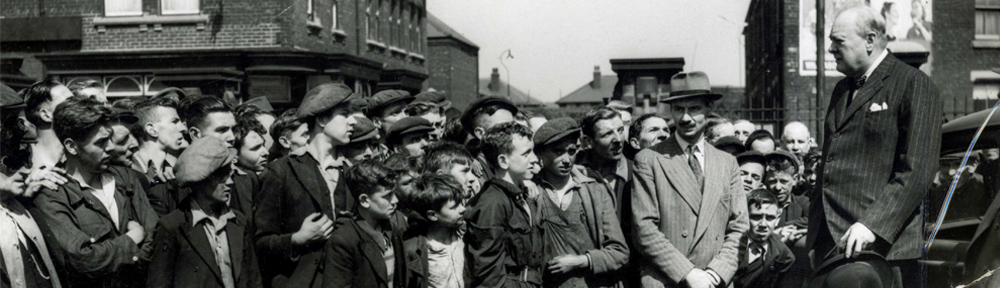
This photograph was taken in Bridge Road, but the reason for the people gathered together is unknown. Can anyone help?
Photograph courtesy of Anon.

It could be Norton and Stockton Ancients I’m not sure. Second from the left is Norman Bellerby and right in the centre is Peter Bonner. The rest I’m afraid are unknown.

A view of the Spare Mans Hut. Taken at Cargo Fleet Works in September 1986.
Photograph and details courtesy of Robert Greenwell.

These photographs showing the site of Teesdale Business Park before construction, were taken from atop the Castlegate Centre car park. c1987.
Photographs and details courtesy of MF Wilson.


I can date this photograph to the 1950s but that all the information I have on this unknown group outing.
Photograph and details courtesy of Anon.

My father played in this football team, but unfortunately he can’t remember the name of the team or what year it was. The only people he remembers start right in the centre of the back row with Steve Strachan, the four before that are unknown then after Steve are Keith Daley, unknown Eric Jones, Norman Bellerby, unknown. First row Tommy Mustard, Derek Overton. Sadly the rest won’t come to him. Can anyone help?
Photograph and details courtesy of Anne Bellerby.

Anderston Foundries occupied a massive site next to the railway track in Port Clarence on the north/east side of the Transporter Bridge. These two adverts were in the railways section of an old Engineering Handbook. They show that the foundry produced a good range of rail track equipment, including crossings and points.


Not surprisingly, the overseas market is highlighted in the main advert. In this country, with the introduction of welded track and reinforced concrete sleepers, the steel sleeper, rail chair and fishplate market was disappearing. Nevertheless, the Anderston Foundry were doing the right thing in having an office in Victoria Street, London. No distance from Westminster Abbey.
Images courtesy of Fred Starr.
Two photographs from Newtown Infants School. One showing the staff and the other the pupils celebrating the marriage of Prince Charles to Lady Diana Spencer in 1981.


Photograph and details courtesy of Anne Bellerby.
A photo just recently obtained courtesy of Peter Jennings. I’m 5th from the right, top row. Lots of faces I remember, names not so much.
Details courtesy of Gordan Finch.

I wonder how many copies of the Stockton Darlington: one hundred and fifty years of British Railways book are still around, which was published in 1975 to commemorate the 150th Anniversary of the Stockton and Darlington Railway? Only recently did I realise that it was written by Peter Semmens, who worked at ICI Billingham. He joined ICI in the early 1950s after doing chemistry at Oxford University. He left Billingham in the 1970s for a senior position at the newly formed National Rail Museum at York. But while on Teesside he set up the local branch of the “British Association for Young Scientists”. Some people must remember him. He must have been quite a dynamic personality.
Peter was an avid enthusiast for the railways, and was one of the four people behind the formation of the National Rail Museum. As such he was more than a train spotter. He contributed many articles to Railway Magazine on the timings of express trains on the East Coast line and was an adviser on the Channel Tunnel. His book on the Stockton and Darlington is more technical than it looks. More important is “How Steam Locomotives Really Work” which Peter wrote in conjunction with Alan Goldfinch, who had been Chief Mechanical and Electrical Engineer in the Eastern Region of British Railways.
Photograph and details courtesy of Fred Starr.

Some class photos of my time at Holy Trinity School in Stockton between 1949 to 1953.
Photograph and details courtesy of Keith Thompson.


